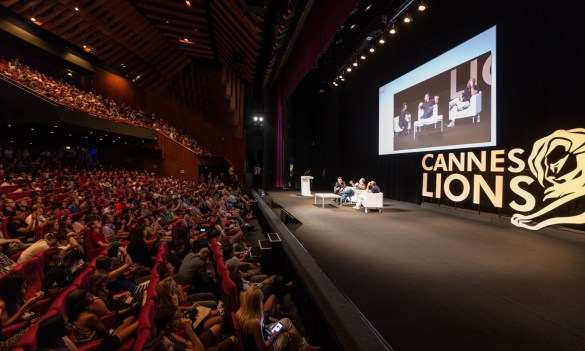
It’s been ten years since I have attended the International Festival of Creativity, the Cannes Lions Festival.
Somethings are exactly the the same. The abundance of awards, drinking, dinners, parties and the networking events held on large yachts.
Dentsu Group companies (Dentsu Inc., Carat (London), 360i (New York), Dentsu Young & Rubicam (Tokyo) and Drill (Tokyo)) were awarded a total of thirty-one Lions (one Grand Prix, one Gold, twelve Silver, sixteen Bronze and one Product Design) at the 63rd Cannes Lions International Festival of Creativity (June 18-25), Lions Health Festival (June 18-19), Lions Innovation Festival (June 21-22) and the inaugural Lions Entertainment Festival (June 23-24) held in Cannes, France.
The Dentsu Group Grand Prix Lion winner was “Life is electric” for Panasonic Corporation.
The insight for this work is very powerful. What if we could see electricity? It managed to use the power of design to change the perception of a product that has become a commodity, by bringing storytelling in—in every space. It creates a bridge between the digital tools and the analog world. A great piece of work.
Dentsu team with the Grand Prix Design Lion
Dentsu Inc: – Cannes Lions International Festival of Creativity
Cyber: Two Silver, one Bronze
Design: One Grand Prix, one Gold, six Silver, one Bronze
Direct: One Bronze
Film: One Silver
Film Craft: One Bronze
Media: One Silver, one Bronze
Mobile: One Silver, one Bronze
Outdoor: Three Bronze
PR: Two Bronze
Product Design: One Product Design
Lions Health Festival
Pharma: Three Bronze
Lions Innovation Festival
Creative Data: One Silver, two Bronze
The three minute award entry show reel continues to drive what entities are awarded and what isn’t.
If you can’t tell a three minute video led story on why your work should be awarded, you have no chance of finding a jury judge interested, no matter how effective your results were for your client.
What is very different for me is how much Cannes has turned into a tech show. A Consumer Electronics Show crossed with a watered down SXSW festival.
I remember ten years ago Microsoft just starting to make a presence on the ad scene. Now it’s all about the big showy setup from Google, Facebook and Twitter and a thousand other tech venders attending all shouting for attention. Advertising has certainly transformed from a festival celebrating print, radio and film to an event all about digital advertising tech led solutions.
So many talks seem to be about promoting tech and the benefits of big data, virtual reality and audience demand generation platforms rather than a celebration on how a big strategic and creative idea can deliver brand impact and business growth.
What has also changed is how separated the creative and media agencies are in operation, focus and collaboration with each other. Creative agencies are now creating ideas with a no canvas approach but it often does not support the media agencies approach to an endless amount of platforms both online and offline to push the message. Too often the creative idea is not made for the media channel to amplify.
This is very apparent at the Cannes event itself.
Advertising messages are planted everywhere. Sure it’s a ad event but the ads themselves are not for client brands but rather have been purchased by tech ad vender solutions.
This means all the outdoor advertising is very average creative work. It is a very polluted ad environment as no brand is making an impact on the audience. It would seem every iconic building in Cannes has some type of tech vender ad message screaming out for attention.
This to me is a miss opportunity. Cannes should be a celebration of beautiful brand client advertising rather than a place to showcase bad ad executions from partners and venders.
Sure I get the event is a money making exercise, but I find the work so bad and disturbing and such a missed opportunity to program the event as showcase for the power of great advertising to our clients.
While the event is held over seven days I think that is too long to hold people’s attention. You can feel very contraphopic within 24 hours of arriving as their are so many limited ad themes to speak about. There is so much overlapping talk on Big data, virtual reality, experience design being talked about without any real authority or case examples.
The event attempts to bring in other industries to pad out the ad talk. All the agencies tend to invite big name guests from the film, music and business industries to flesh out their points of view.
Over the last ten years I have elected to attend SXSW for my creative inspiration over Cannes, and I think based on this years experience it continues to be a wiser choice. There is much more diversity and authority in Austin over Cannes in how to grow brands and business using innovation.
As I was only six weeks into my new job as CDO in the Dentsu Aegis Network I found the timing of Cannes very convenient to meet up with colleagues from around the globe and receive a debrief on our network strategy and capabilities and our journey to 100% digital.
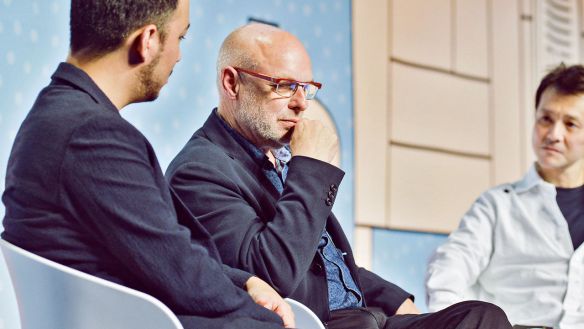
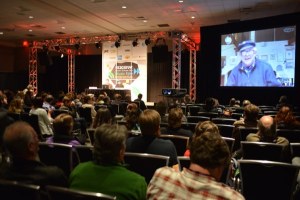
When not in meetings I attended the conference hall seeking out inspirational talks. One highlight was a conversation with Brian Eno and Dentsu Lab Tokyo on their project to explore whether machine intelligence (MI) can acquire the creativity that is innate to human beings. Brian hired Dentsu to work on his latest project called The Ship.
I have always had a man crush on Eno the musician, producer, visual artist, creative thinker. I remember when I first heard U2’s The Unforgettable Fire when I was about 15. I was so amazed with the abstract sound on that album. It was so different to U2’s previous albums like War. I remember reading the album credits and seeing for the first time the names Brian Eno, Producer and Daniel Lanois, Sound Engineer.
Eno changed how music was recorded. He mastered the multi track technique. His work with Roxy Music, David Bowie, Talking Heads, Ultravox were the soundtracks of my life. I studied in sound engineering and manipulation because of this man so it was great to meet him after the talk.
Every year SXSW in Austin becomes both a conference and a festival offering the unique convergence of emerging technologies, original music, film and television.
SXSW 2015 starts on March 15 and runs to March 22, with programming focuses on creativity, innovation and inspiration across various media industries. The Internet continues to change the business of media and marketing and the week’s goal is to foster creative thinking and professional growth alike.
SXSW is the premier destination for discovery in my mind and my fourth year attending didn’t disappoint me. My previous SXSW blog posts can be found here;
Year after year, the event is a launching pad for new creative content and there were hundreds of new media presentations, music showcases and film screenings that with Austin opening some new hotels seem to spread the massive crowd to deliver a real world socially fuelled event platform that was both informative and entertaining.
Austin continues to serve as the perfect backdrop for SXSW, where the environment is perfect for career development amid the relaxed atmosphere.
Intellectual and creative intermingling among industry leaders continues to spark new ideas and carve the path for the future of each ever-evolving media field, and connections are made that remain strong long after the events’ conclusion.
The meeting of old SXSW friends and finding new ones allows you to test new learnings. SXSW is alive instead of programmed and you feel ideas as much as think about them.
My SXSW 2015 schedule for the week can be found here. Below are my insights from what I experienced and took away.
Five things I learnt at SXSW 2015
1. Evolve your company structure and rules to maximise an ever-changing world so wisdom can come to your workforce
It seemed I was not the only one seeking out new ways of working in teams. What was interesting at SXSW was the number of USA government officials attended the conference than ever before. Between senators, congressmen and administrators, about 40 Washington influencers were on the ground. Everyone from New York Rep. Hakeem Jeffries (D-N.Y.) to Cathy McMorris Rodgers (R-Washington) were speaking on panels and mingling with entrepreneurs. They were all learning about technology and bridging the gap between Washington, D.C. and innovation and the changes in community. Discovering techniques on how companies organise or create high performance teams to delivery creativity, results and innovation was top of mind.
A couple of good examples of people thinking included Nicole Glaros, Partner, Techstars Ventures & Chief Product Officer at Techstars talk titled Jedi Mind Tricks for Entrepreneurs. Nicole has a master’s degree in sport psychology, and a background in helping athletes overcome obstacles.
Don’t fire employees after a major mistake, embrace them was a key theme on how to get innovation happening . Conscientious employees won’t make that same mistake again and will be more loyal to you because of how you treated them.
Furthermore, you won’t have released a newly wiser person into the workforce to get scooped up by the competition. “Your best person is the person who just screwed up,” she says, “When people fear for their job, they aren’t going to [take a risk].” By treating your employees with affection, you create camaraderie and collaboration. “Creating an environment where you can be vulnerable is a powerful thing to do,” Glaros says. No one will succeed until they feel comfortable admitting to failure.
One instructional talk was from Brian Robertson who left a stable job and founded Ternary Software, a start-up software company that became a laboratory for experiments designed to answer the question what gets in the way of people working together as effectively as possible? In the most efficient way possible?. He learnt a lot on this topic and found techniques to remove organisation obstacles.
After a number of years on consulting on the topic he went on an founded Holacracy that is essentially a real-world-tested social technology for purposeful organisation. It radically changes how an organisation is structured, how decisions are made, and how power is distributed.
Holacracy is a distributed authority system – a set of “rules of the game” that bake empowerment into the core of the organisation or team.
Unlike conventional top-down or progressive bottom-up approaches, it integrates the benefits of both without relying on parental heroic leaders. Everyone becomes a leader of their roles and a follower of others’, processing tensions with real authority and real responsibility, through dynamic governance and transparent operations. One of the larger companies that use Holacracy thinking is Zappos.
2. Wearables are in right now, at least when it comes to experimentation.
I’m sure it will take some time for the sector to find that right level of refinement, be it through insight or trial and error.
Intel views wearable technology as the new frontier of computing. The level of intimacy of wearable technology opens up a world of transformative experiences that is different from a smartphone. The devices on show in various trade halls are all aimed to enrich the users experience especially in fitness and health by providing data that can increase motivation, enhance training and ultimately improve performance.
This recognition is leading to some pretty interesting alliances between engineers, designers, marketing experts and sports scientists. The trend of “smart fabrics” where sensors are embedded directly into the fabric vs. existing on external devices is another example of where fitness-oriented wearables are headed. Wearables offer a level of intimacy and personalisation that cannot be matched by a smartphone, in addition to delivering more precise measurements by virtue of being closer to the body.
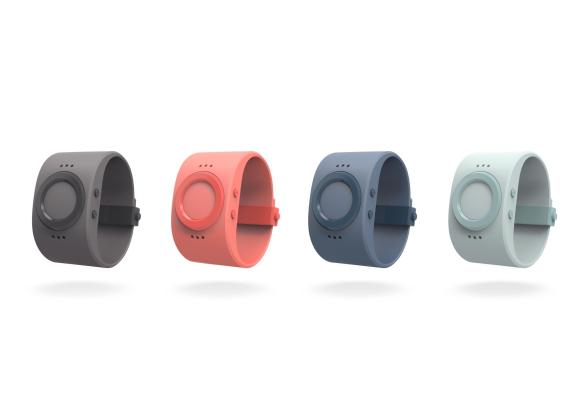
Tinitell the Kickstarter backed project, which is the brainchild of CEO and founder Mats Horn is essentially a phone that a child wears on his or her wrist, packing a week’s battery life (with 60 minutes talk-time), GPS and GSM connectivity, and a durable water resistant design. Very cool designs
Tinitell, a Swedish startup that makes a GPS tracking smart watch designed for kids, won the SXSW Accelerator Award for the wearables category.
3. Robots are now curating more and more content experiences but the speed is at the cost of craft.
Three years ago, media and advertising companies would say at SXSW they didn’t think it was possible to have robots or software write news articles and write ads. Now it would seem every single major news and media organisation will roll out at least one kind of automated product by the end of the year just to stay relevant.
Media Automation is on the increase
With mankind developing innovative ways to augment machine, what will happen to human journalists, human creative writing of any form if robots are introduced as writers more and more. Automation as theme at SXSW continues to gather speed and the biggest industries to be impacted is news media and advertising. Both for different reasons but both certainly impacted.
Machines are taking over. Programmatic, real-time bidding, automation and the finding of audience, the buying and selling of digital media is increasing but I didn’t feel it was making an impact for dollars spent yet. Over 70% of all digital advertising is now sold by one machine talking to another machine, and its growing more with every passing week. Publishers are desperately grasping onto business models that ignore old ethical boundaries and bend to media buyers will and in the process trade away their core value proposition to engage audiences.
Thank god for the experience killer creative content at MOFILM’s Industry mixer event. Hosted by actor/director John Slattery, MOFILM’s legendary hospitality, stimulated and sate my appetite that branded advertising content is still very relevant and not one machine was in attendance.
4. The business of Sport Media is getting even bigger, louder and has no off season.
SXsports™started in 2014 as a new convergence track of the annual event. The three-day, sports-focused programming features panel sessions, film screenings and meet ups. SXsports explores cultural impact and the human experience, tackles the future of sport in all its forms, and embraces entertainment and innovation.
Consumer expectations and behaviours at events have changed
So many great panels but one I enjoyed a lot was Social Media Playbook: Activating Fans on Gameday, where they presented some case studies that explained how consumer expectations and behaviours at events have changed dramatically in the past five years– and how those expectations are being met at sporting events.
According Brian Cheek, Director of Business Development at Postano and the other panelists, Wi-fi is now a requirement, fans check-in and order food with apps, and Instagram photos and selfless are the new proof that you attended a game at the actual stadium or arena. But key to it– the best part– is that they are using big screens in the venues to create the experience. It’s not about thousands of random posts. It’s about bringing all that together on huge digital screens to create the experience.
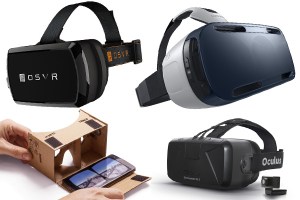
Virtual reality is a pipe dream no longer; the technology is here, and it’s awesome.
Virtual and augmented reality took centre stage at this year’s SXSports where audience members were shown demonstrations on how the technology is being used in sports. A popular panel was The Future of Virtual and Augmented Reality in Sports with presenters Bob Bowman, President and CEO of MLB Advanced Media; Brent Dewar, Chief Operating Office of NASCAR and Rachel Nichols, Reporter for TNT/CNN. The discussion focused on the technology NASCAR and MLB have in place for their teams and fans. The biggest problem MLB must overcome is the pace of the game. Bowman says it is not realistic, they are looking for ways to eliminate the time between innings and pitches. He says viewers tuning in have a higher chance of seeing action if the pace of the game quickens. Bowman says the future of technology in baseball will include “mundane things” like being told which parking spaces are open, having tickets pop up on your phone as you enter the stadium, and being able to see which concessions have the smallest lines.
At the panel Acing the Sports Game with Oculus Rift, audience members were given cardboard cutouts with specialised lenses. They downloaded a Beyond Sports app on their phones and placed it in front of the cardboard cutouts. They were transported into a video game like soccer pitch. The panel members from Triple IT ran through plays where the audience members could see animated soccer figures running around them.
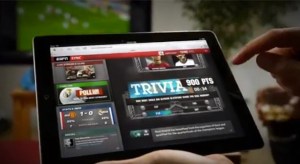
Second Screen Sport Experiences
At the panel What’s in your Living Room? with presenters Jeff Beckham, Writer for Playbook/Wired, Mark Kramer, Head of Digital Technology at Pac-12 Networks, Spencer Hall, Editorial Director for Vox Media/SB Nation and William Mao, Head of College Sports Partnerships for Youtube. The panel members focused on the transformation of television and how fans will be watching sports on TV in the near future. A good comments was “I think what I really want is the TV to know who I am,” Mark Kramer said. “I want it to know what I like, and for it to deliver linear TV to me.
We have this with Facebook where Facebook knows what you like and builds on that. We need the ability to personalise the entire TV experience: It can give you ads, it can give you offers, a number of incredible things.” Spencer said “People in sports want the shortest points to content and they don’t want the line around the fence, they will cut through the fence.”
5. Film is still the most inspiring and effective form of story telling.
Thousands arrive in Austin, Texas, to attend the film festival component. While there is not as many distribution deals as at Sundance or Toronto, SXSW is starting to be a big launching pad for upcoming releases and focus for streaming on demand services.
Fresh off the debut season of his HBO comedy-drama “Togetherness,” the actor-director-producer and writer Mark Depluss delivered a rousing SXSW keynote about his successful indie experiences and his new Netflix deal. Worth a look when you have 45 minutes.
A few films that stood out wereA Poem Is a Naked Person (24 Beats Per Second) a music-related documentary which was a unreleased 1974 feature by the late Director Les Blank about ’60s stellar session musician-turned-Me Decade headliner Leon Russell.
Lamb the novel by Bonnie Nadzam is a deeply uncomfortable drama inherently disturbing meditation on virtue and vice, by actor and director Ross Partridge, blurred lines between them that present themselves over the course of one 47-year-old man’s spur-of-the-moment camping trip with an 11-year-old girl he befriended in a burned-out Chicago parking lot. The film is as dangerously compelling and quietly terrifying as that premise suggests.
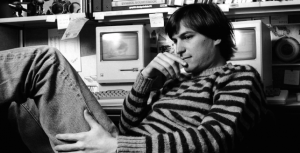
Steve Jobs Man in the Machine
Another dark and reflective film was Steve Jobs: The Man in the Machinea documentary feature by Alex Gibney who is best know for his controversial Sundance film “Going Clear: Scientology and the Prison of Belief.”
His portrait of the Apple entrepreneur’s life and legacy is very confronting, brutal, mostly one-sided take on the late Steve Jobs. I am sure more will be said from Apple Executives over the coming weeks.
My favourite quote from the film sessions was from Brian Grazer the Academy Award–winning producerof A Beautiful Mind, Apollo 13, Splash, Arrested Development, 24, 8 Mile, J. Edgar. “The grey area between the question and the answer is where ideas are created.” The crux of Brian’s creativity stems from what he refers to as “curiosity conversations.” He meets with people who are experts in something other than show business. Subjects like politics, science, medicine, religion, and anything else is where he spends considerable time.
Conclusion: Get more curious and it’s OK to get emotional.
There is a genuine sense of discovery, inspiration and awe at SXSW like no other conference or festival in the world can create, and despite it being a hot mess of conflicting themes, brilliant innovation and over exuberance I think it works so well because it is all of these things.
My fourth year at SXSW I found the week fundamentally much more now an emotional experience as it is a high tech and creative one. Thank you to everyone I met, the meetings, the talks and the gatherings and the long nights. SXSW does not ever seem to disappoint and I’m so lucky I was able to attend.
A big thanks must go to my employer Telstra for giving me a week out of the office to experience and learn.
muru-D is the start-up accelerator backed by Telstra looking to support the very best digital talent that the Australasian region has to offer.
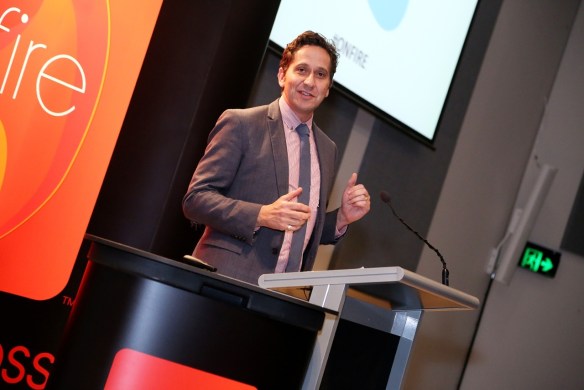
on fire™ series one ‘Pass on the passion’ was created and hosted by muru-D on April 15th, 2014 in Surry Hills Sydney.
This curated series hosted by Kylie Jaye was produced by Telstra Media and broadcast services from Chief Entertainment.
The series features a vast array of amazing mentors and startups, sharing their passion to stimulate and encourage everyone to do big and small things – every day.
Speakers for series one are;
Ann Parker, co – founder of muru D Start up Academy Stuart Fox, Managing Director Artesian Capital Chris Adams, CEO founder Spondee Audette Exel, Co- Founder, CEO Isis Group, NED Suncorp Naomi Simson, Founder CEO Red Balloon Richard Webb, Founder Red Ocean, Chairman & Founder Effective Measure Mick Liubinskas, Mr Focus @ muru D & Founder Pollenizer
I was delighted with the day and much thanks goes to Kylie Jaye for producing the great event. It was a pleasure to close the day and thank all the speakers who donated their time. we look forward to doing more in the future.
Adam Good Telstra Media Muru D On Fire Series 1.
We believe that whilst an idea is the kernel to innovation, it is passion that gives us the power, tenacity and energy to make those ideas real.
Passion gives purpose and meaning for us to dive deep and push beyond our comfort zone. Passion is the courage to ask ‘why not’ and to expect the extraordinary.
It may spark just one tiny change at a time but that spark leads to a fire that grows ideas into businesses, changes attitudes, improves lives and helps others be better in every way.
Australia’s #1 media and marketing conference is back!
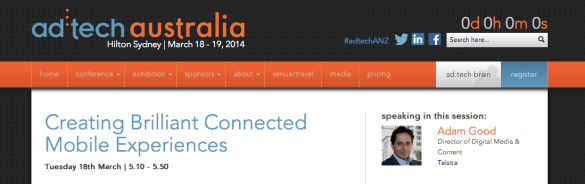
Today the Sydney Hilton is packed enjoying a completely reshaped program from the ground up. This year Ad tech is focussed to better serve the needs and interests of Australia’s media and marketing industry.
It’s been exciting to be part of the event program as both an advisor and closing keynote speaker of day one.
It’s my third year attending South by Southwest (SXSW) my favourite film, interactive and music conference hosted in Austin Texas.
No doubt SXSW has now become one of the most important cultural and economic incubators of the new millennium. Every March, more than 40,000 people, including a Who’s Who of innovative executives and entrepreneurs, flock to Austin for the ten-day festival. They debate the future of business and the Internet. They wheel and deal. They party. They wake up and do it all over again.
The event offers a unique convergence of emerging technologies, original music and independent films that foster’s the creative and professional growth of anybody who has a career in the communication industry.
My SXSW 2012 experience was all about the transmedia learning I gained at the event.A year later at SXSW 2013 it was all about a week that demonstrated clearly to me, that the progression of technology is increasingly shrinking the lag time between what we can imagine and what we can create.
This year the conference has had a big focus tech safety and security. They also had a wonderful new sport stream where I was a considerable amount of time. But like previous years you learn to just go with the flow and always be looking up. My event schedule That outlined everything I attended can be found here,
From past experience you need to be very flexible with your daily plans and let each day take you on a creativity discovery based on the people you meet and the conversations that are had.
Some of my highlights on SXSW 2014 are listed below;
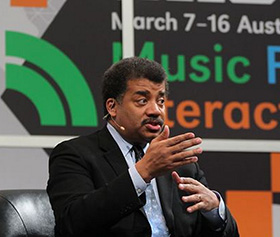
There was a massive turn out for the keynote Dr deGrasse Tyson who was amazing with some memorable quotes. “Science literacy is how much do you still wonder about the world around you. What is your state of curiosity?” or “I would encourage you to not become attached to the number of things. There’s no physics in the number of things.”
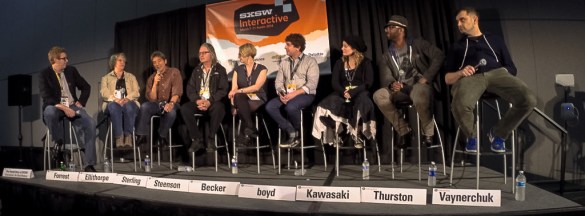
I attended the Fast Company event of some of the original SXSW Interactive event coordinators giving the untold stories behind Twitter, Foursquare launches at SXSW as well as the famous keynote in 2008 from Mark Zuckerberg which defends into chaos as the audience takes over the twitter back channel. SXSW Interactive has certainly come a long way in a very short time.
I also attended a talk with Ralph Steadman who I have always been a fan of his art, wit and satire. One that I remember that know doubt I will use is ‘a good idea runs away with itself in case of a theft’ or ‘a mistake is an opportunity to do something else’.
I attended the premier of Penny Dreadful the new John Logan TV series that starts on Show Time. It was chilling and makes Walking Dead look like a kids show.
I was invited for the second year in a row the MoFilm awards at the Driskhill Hotel. A great night and wonderful combination of wonderful T-Mex food and branded content. I love them both. I spent good amount of time with the AT&T group who are doing a lot of this branded film work. See the finalists here
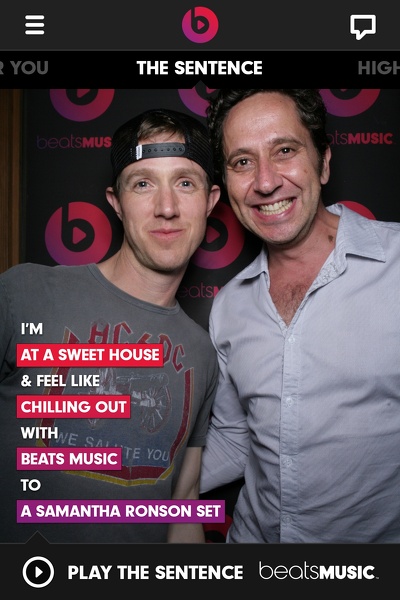
I attended the Beats Music party and I encourage those that are in the USA to download the Beats Music app and give the SXSW playlist a listen. Below is a photo of myself with Beats Music CEO Ian Rogers on the night. Currently Telstra distributes MOG in Australia which was acquired by Beats Electronics a year ago. Beats Executives gave insight into there exciting plans and roadmap for music streaming. I can’t say what was discussed but rest assured it is big news that will transform the way people experience music. Telstra is excited to work with such wonderful partners and look forward to launching a big music offer to our customers in 2015.
I attended a Conversation with Jon Favreau the writer, actor, director, producer of the Swingers and big productions like Elf and Iron Man. He has an indie film here called Chef premiering here which I didn’t get to see yet. It was an inspiring talk about working in cross function and collaborative teams,
I spotted Google Glass approximately .000034 seconds on arriving in the conference halls. They really look stupid I have to say. No-one looks good wearing these.
On films I also saw the Speirig brothers new film called Predestination with Ethan Hawke. This is funded by Screen Australia so plenty of Aussie’s in the house. A riveting piece about time travel. Such good story tellers. An entrancingly strange time-travel saga that suggests a Philip K. Dick yarn by way of Jeffrey Eugenides’ “Middlesex,” or perhaps a feature-length mash-up of “Looper” and “Cloud Atlas,” Wonderful performance by Sarah Snook.
This is obviously only a fraction on what I attended and saw. On the last day I enjoyed a film called ‘Fort Tilden’. A comedy about Allie and Harper and their needlessly difficult journey to the beach. A great script, awesome dialogue and a worthy SXSW Grand Jury Prize winner.
This week I attended the Mobile World Congress in Barcelona with another 85,000 other visitors from over 200 countries. It was my first time at the mobile industry’s premier event and I thoroughly enjoyed the experience.
Mobile World Congress features more than 1,800 exhibiting companies showcasing cutting-edge products and services across 98,000 net square metres of exhibition and meeting room space. The four-day conference and exhibition was a wonderful time to meet with executives from the world’s largest and most influential mobile operators, software companies, equipment providers, Internet companies.
The conference programme featured Mobile World Live keynotes from Mark Zuckerberg, Founder, and CEO, Facebook and Virginia Rometty, Chairman, President and CEO, IBM which gave the week a real software flavour.
I saw a number of flagship smartphone launches, several new wearable devices and some innovations from several car brands. This was cool but I wanted to go deeper and wider so I ventured out to Fira Montjuic which is outside the main halls from day three. Here I attended the Mobile Media Summit, HACKATHON and 4 Years From Now (4YFN), a mobile entrepreneurship and innovation event created by Mobile World Capital.
I heard talks and saw innovations that really brought to life where the mobile video traffic is going and what experiences are going to take up the expected growth of more than 75% year on year of mobile data.
My entire week was focused to learn more about the future digital multi screen media experiences, TV anywhere services and an end-to-end integrated platforms for service providers to engage deeper with customers. What I saw was the depth of new interactivity and multi-screen capabilities to deliver OTT video was staggering and seeing this all from a mobile first perspective gave a lot of insight to the future of media in general.
There are now so many more way consumers are using smartphones to work, live, and entertain. Mobiles are true rich media devices now. The increase in screen size, display quality, HD imaging capture and a clear momentum behind 4G is all pointing to come together to open to make rich content experiences on-the-go viable for end users.
The demands and opportunities this places on service providers no doubt requires strong leadership in crafting strategies to combine fixed, to wireless, to LTE, and, in the future, 5G programs to match customer demands that build each year.
As a media guy I learnt through the lens of network and engineering professionals about the intersection of TV, media and telecoms and the strategies required to partner with broadcasters and cable operators around the world to make content available across any screen. The high quality video content on mobile devices that LTE Broadcast gives customers a new mobile media experience that is very exciting.
I was also wrapped that Telstra and partner Ericsson picked up an award for Pushing the Limits in mobile technology at the inaugural Telecoms.com Industry Awards at Barcelona for their work on LTE broadcast technology. In late 2013, Ericsson and Telstra conducted the world’s first LTE Broadcast session on a commercial LTE network, allowing the operator to send the same content simultaneously to a very large number of devices in a target area, achieving efficiencies not possible before.
This was very relevant and when I watched the keynote panel called The Battle for the Multiscreen Home, the discussions rested around three main areas: mobile as a “door to the internet”; mobile as a stand-alone product opportunity; and mobile as part of new integrated experiences, which also span across linear TV and the wider web.
The term ‘living media’ was heard a number of times during the week best explained as the seamless integration of linear programming, second and third-screen content, viewer and cast interactions, and broader social media. This will obviously raise the bar for content providers and advertisers as it requires a shift to start rethinking the use of television and media not only from a consumer perspective, but also that more television services are landing on mobile and PC devices, and not on actual television sets as we go forward.
Another interesting trend I saw was that smartphone seems to be developing in increments now. Despite two big announcements from Sony (the Z2) and Samsung (the S5) I didn’t see anything amazing. What was a clear trend was cheaper smartphones and really all phones now are internet enabled making the rush to connect the next billion people globally as a major focus of so many organisations, including Facebook.
The facebook acquisition of WhatApp, the over the top mobile messaging platform was a constant side discussion at Mobile World Congress. Mark Zuckerberg’s appearance this year was significant on a number of levels and the showdown between app-builders and networks about ownership of messaging as the call experience on smartphones is going to be fascinating thing to watch over the coming years.
While there may have not been much new in smartphone hardware, it is not true of software, where the battle to own the mobile user experience being hotly contested.
Android is becoming ever-more dominant as a platform for the ‘internet of things’ and it is a testament to the growth of Google’s platform they are in everything. No doubt Google will continue to be increasingly important part of the digital marketing tech and advertising universe for many years to come.
There are now true signs, research and example that mobiles could yet shape how we choose to watch TV, and of course, how we experience TV advertising. This brings me to my main observation of the week. The sheer volume of advertiser and marketers attending Mobile World Congress from outside the telco industry this year underlined the increasing influence mobile has on the advertising industry.
Coca-Cola brought 15 marketers out to Barcelona, Unilever had a strong marketing contingent and there was even a whole separate fringe show at MWC’s old venue via the Mobile Media Summit.
There were speakers from the likes of Twitter, the BBC and Walmart. Announcements made from such brands at the show demonstrated how mobile is shifting from becoming a minor part of the media plan to a major part of the business process. The mobile ad strategy is shifting from pop-ups and banners to more native and immersive forms of marketing.
The first ever showing of the Mobile Media Summit at Barcelona was significant and congrats to my good friend Paran Johar for putting on such a great show. The key trend of the event was that brands are using mobile as part of a native advertising approach. While the idea of programmatic and real time marketing is also on the rise, native is an ideal strategy to connect with consumers.
If you also add in the growing appetite for wearable technology and devices expected to grow by 947 per cent by 2017, big brands are watching and learning. Mobile marketing is going to continue to challenge everyone but one thing is for sure it is here to stay.
My key take aways from the conference is companies and brands need to focus on creating a totally customer centred operating experience that integrates living media, secure utility, seamless multi screen and if possible some wearable product innovations.
The Association for Data-driven Marketing & Advertising – or ADMA – is the largest marketing body in Australia. Members of the organisation are among the leading advertisers, marketers, agencies, fulfilment, telemarketing and production companies from across the country.
The marketing industry has faced unprecedented change over the past few years with new channels, new technology and new consumer models have accelerated.
ADMA Engage 2013 is Australia’s only data-driven customer engagement event for marketers and advertisers to take stock of this change and hear from the industry. The event takes place at Luna Park in Sydney and the Melbourne Convention and Exhibition Centre on November 12th and 14th . The two day event’s goal is to provide real and practical insights that marketers can apply to their own customer engagement initiatives.
ADMA asked me to speak at Engage and bring a highly relevant and extremely focused talk to the event. I decided on Engaging customers across multiple screens, anytime and anywhere.with an attempt to showcase how to develop and deploy integrated cross-platform content experiences for IP connected screens. Multiscreen is one of the biggest marketing challenges brands will face over the coming years as more connected devices come to market. Reaching the same consumer across screens offers substantial opportunities to make an impact throughout the entire purchase funnel from awareness through to purchase intent.
My talk spoke to how marketers should collaborate with publishers on brand experiences that scale fluidly from the largest of screens to the smallest. Below is the presentation. If you have any comments please don’t hesitate to contact me.
Google’s Digital Dialogues content series brings together marketing, advertising and media executives to talk about how digital trends like video, multi-screen, and programmatic are reshaping the marketing and media industries.
I was asked by Jason Pellegrino, Sales Director for Google Australia and New Zealand to hangout and talk how Telstra Media is creating and monetizing digital video content to engage our audience.
Online advertising expenditure in Australia in the past year to 30 June has leapt 14.6 per cent to $3.6bn, according to the latest Interactive Advertising Bureau (IAB) figures.
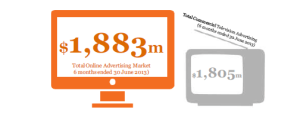
One of the surprises over the first six months of the year was that total online advertising exceeded free-to-air television spending for the first time since the report began in 2002. According to the IAB, online expenditure was valued at $1.88bn against $1.8bn on television.
The annual Online Advertising Expenditure Report, produced for the association by PricewaterhouseCoopers, found mobile continues to outpace other categories in terms of growth, increasing 190 per cent year-on-year. Search and directories advertising rose by 18 per cent over the same period, while general display was up by 12 per cent.
Australia’s online advertising market contributes $17.1bn to the nation’s GDP and provides more than 162,000 direct jobs, according to the new Digital Dollars report. The first-of-its-kind report was commissioned by the Interactive Advertising Bureau (IAB) and completed by PriceWaterhouseCoopers, and is based on the 2011/2012 financial year. Alongside the current economic result, the report also claimed the online advertising will be worth $26.5bn by 2017, reflecting a compound average annual growth rate of 7.5 per cent.
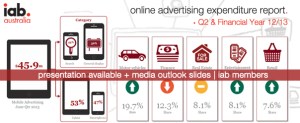
In its previous March quarter report, the IAB found tablet-based advertising was exceeding smartphone spending within the mobile category, representing 58 per cent of total spend. Over the most recent quarter to 30 June, mobile spend reached $45.9m and again 58 per cent was tablet-based.
Over the April-June quarter, general display advertising accounted for 27.3 per cent of all online advertising ($265.6m), while classifieds advertising represented 18.9 per cent ($183.3m)and search and directories 53.8 per cent ($523m).
Video display advertising is also on the rise, and increased by 56 per cent year-on-year in the June quarter to $35.7m. In total, online advertising over the most recent quarter totalled $971.9m, up just over 15 per cent year-on-year.
X Media Lab is the internationally acclaimed creative industries event which creates a meeting place uniquely designed to assist companies and people in getting their own creative ideas successfully to market, through concept development, business matching, and direct access to world-class networks of creative professionals. The “X” in X Media Lab stands for cross-platform, cross-disciplinary, and cross-cultural.
X Media Lab began at the Sydney Opera House in June 2003 and has gone on to deliver over 60 events in 14 countries in 20 of the world’s great digital media cities: Beijing, Shanghai, Suzhou, Mumbai, London, Bath, Amsterdam, Basel, Malmö, Sydney, Melbourne, Perth, Seoul, Kuala Lumpur, Singapore, Jakarta, Manila, Auckland, Wellington, and Los Angeles.
Celebrating its 10th year, X Media Lab, Australia in partnership with VIVID, UNSW College of Fine Art, and the International Symposium of Electronic Art (ISEA) produced the KR8V Masterclass Series “Creative Leadership Edition” and I was asked to be a mentor and keynote speaker. I was delighted to be involved.
What I have always found with each X Media Lab I have attended is it to be completely unique event where people with original digital media ideas connect with a superb international network of independent creative thinkers, technology wizards, commercialization experts, potential business partners, and potential financial resources to focus on how these ideas can be brought to market.
The talk I gave was on Creative Leadership and how we at Telstra approach our planning and our immediate media future around customer demands. (See below)
 It’s been ten years since I have attended the International Festival of Creativity, the Cannes Lions Festival.


 A couple of good examples of people thinking included Nicole Glaros, Partner, Techstars Ventures & Chief Product Officer at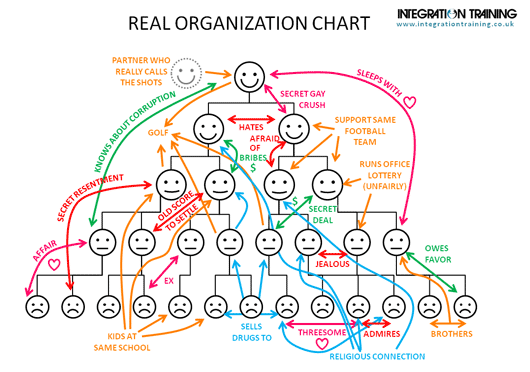







 A journal by Adam Good