
As a founder building in the sensory tech space with Auric Essentials, I spend most of my time immersed in the grind of early-stage company building—designing products, scaling tech, shaping teams, and crafting investor narratives. But occasionally, I carve out space to back other founders whose vision genuinely impresses me. BindiMaps is one of them.
This isn’t a passive investment. It’s a founder-to-founder backing of a company I believe is building a category-defining product with global potential.
A Founder’s Story That Sparked a Movement
I first met Dr Anna Wright, the co-founder and CEO of BindiMaps, back in 2015 at the SheStarts, an accelerator. Her idea was striking not just for its technical ambition but for its emotional clarity.
Anna—a confident finance professional with a PhD and decades of experience in valuations and corporate advisory—had recently been diagnosed with a condition that could lead to permanent vision loss. Rather than accept the limitations of existing tools like Braille panels, white canes, or guide dogs, she asked a deeper question: What if technology could offer genuine independence for people with vision impairments?
That personal insight became the driving mission behind BindiMaps: to make every space navigable—for everyone.
She wasn’t alone for long. Tony Burrett—another BlueChilli alum and one of the most experienced startup product leaders in the country—joined her as co-founder and Chief Product Officer. Tony is the kind of operator who not only ships product but builds platforms. His track record includes building MVPs for dozens of startups, including Australian unicorn EmploymentHero.
With Anna’s strategic clarity and Tony’s product execution, BindiMaps didn’t just emerge—it launched with purpose and velocity.
What They’re Solving (and Why It’s Bigger Than Accessibility)
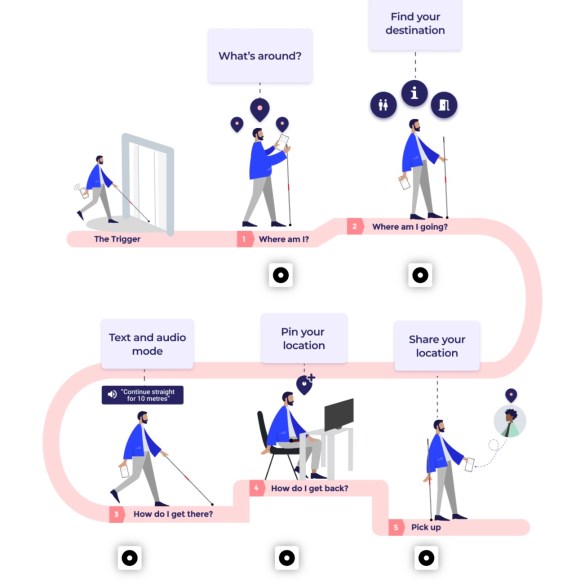
At its core, BindiMaps started as an app to help people with low vision navigate complex indoor environments. But its implications go far beyond accessibility.
Most of us rely on Google Maps or Apple Maps to get around—but as anyone who’s tried to find a specific hospital wing, university lecture hall, or their car in an underground parking lot knows, these tools break down indoors. They simply weren’t designed for it.
What Anna understood early was that accessible design often leads to better experiences for all users. If you build a navigation system accurate enough to guide someone who can’t see, you’ve likely built the best solution on the market—period.
Hospitals spend hundreds of thousands each year directing lost visitors. Missed appointments cost billions. Complex venues—from universities to airports to stadiums—lose time, money, and trust every time a visitor can’t find their way. BindiMaps addresses this with elegance and precision.
The Technology: World-First Innovation Without the Overhead
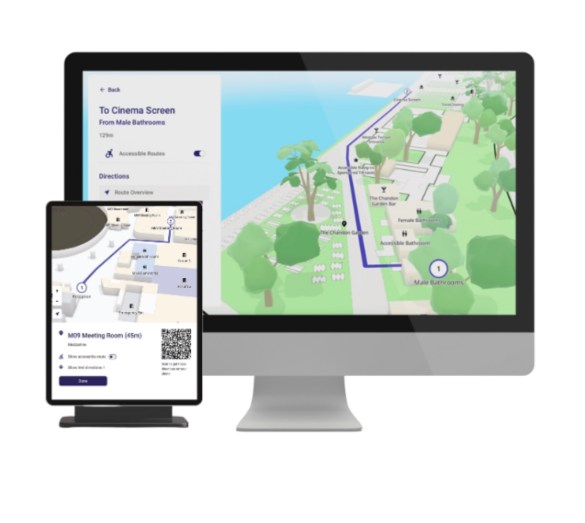
BindiMaps
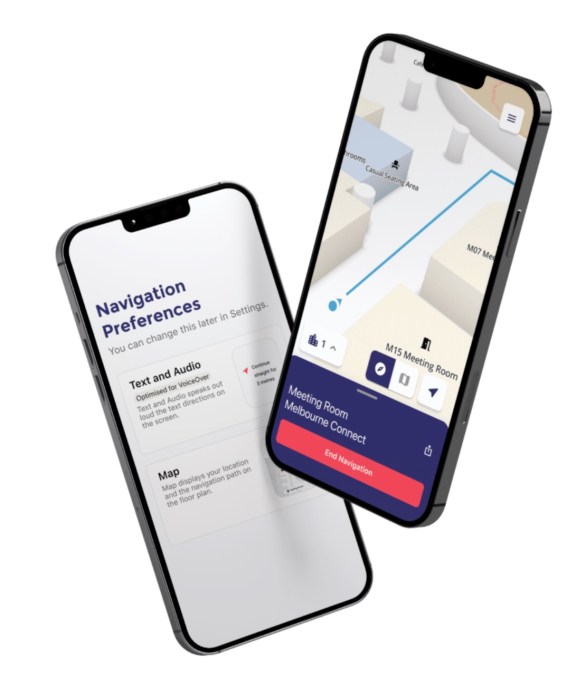
The real breakthrough came with Bindi 2.0, the company’s new infrastructure-free indoor positioning system. Traditional indoor navigation often requires costly hardware installations—Wi-Fi triangulation, Bluetooth beacons, ultra-wideband sensors. BindiMaps now needs none of that.
Instead, using a smartphone or GoPro, a trained operator captures a walkthrough of a venue. Their proprietary ML pipeline, Collie, turns that footage into a 3D point cloud. Then Affie georeferences it, while Landseer uses real-time computer vision to track user location to within 30cm—no GPS, no beacons, no wiring.
It’s technical wizardry with commercial scalability. It makes the product viable not just for massive public venues, but also for smaller retail spaces, clinics, and offices.
Where They’re Going (and Why I’m In)
BindiMaps already works with major Australian property groups like Lendlease, Mirvac, ISPT, and GPT, as well as hospitals, government departments, and events like the Australian Open and SXSW Sydney. They recently signed their first international customer—Budapest International Airport, and have active plans to expand into the US, Japan, and Singapore.
The business model is elegant too: a high-margin SaaS platform with a low churn rate, and deep value for asset managers. Venue owners pay a setup fee and a square-metre-based subscription, while end-users get free access via mobile, web, and kiosk.
But for me, the decision to invest wasn’t just about market size (though it’s big—projected to reach USD $20B+ by 2030), or even about traction (which is strong and growing). It was about backing a founder who’s walked the problem space personally, built an extraordinary team, and created real, defensible IP.
That’s the kind of company I want in my portfolio.
A Final Word
BindiMaps aligns with the same investment thesis I apply to my own work at Auric Essentials: building category-first products at the intersection of human need, data, and sensory technology. Just as we use scent and AI to transform mood and mental wellness, BindiMaps is using machine learning and spatial data to make the world navigable for everyone.
Proud to be a supporter of Anna, Tony, and the entire BindiMaps team. They’re not just solving a problem—they’re changing what we expect from public spaces.



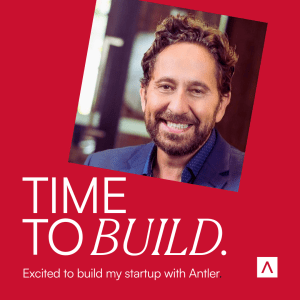














 A journal by Adam Good